IDEAS
From Slate and Slugs to Artificial Intelligence
A lifetime spent watching the tools of information change—and why this transformation feels fundamentally different.
By Eugene L. Morrison
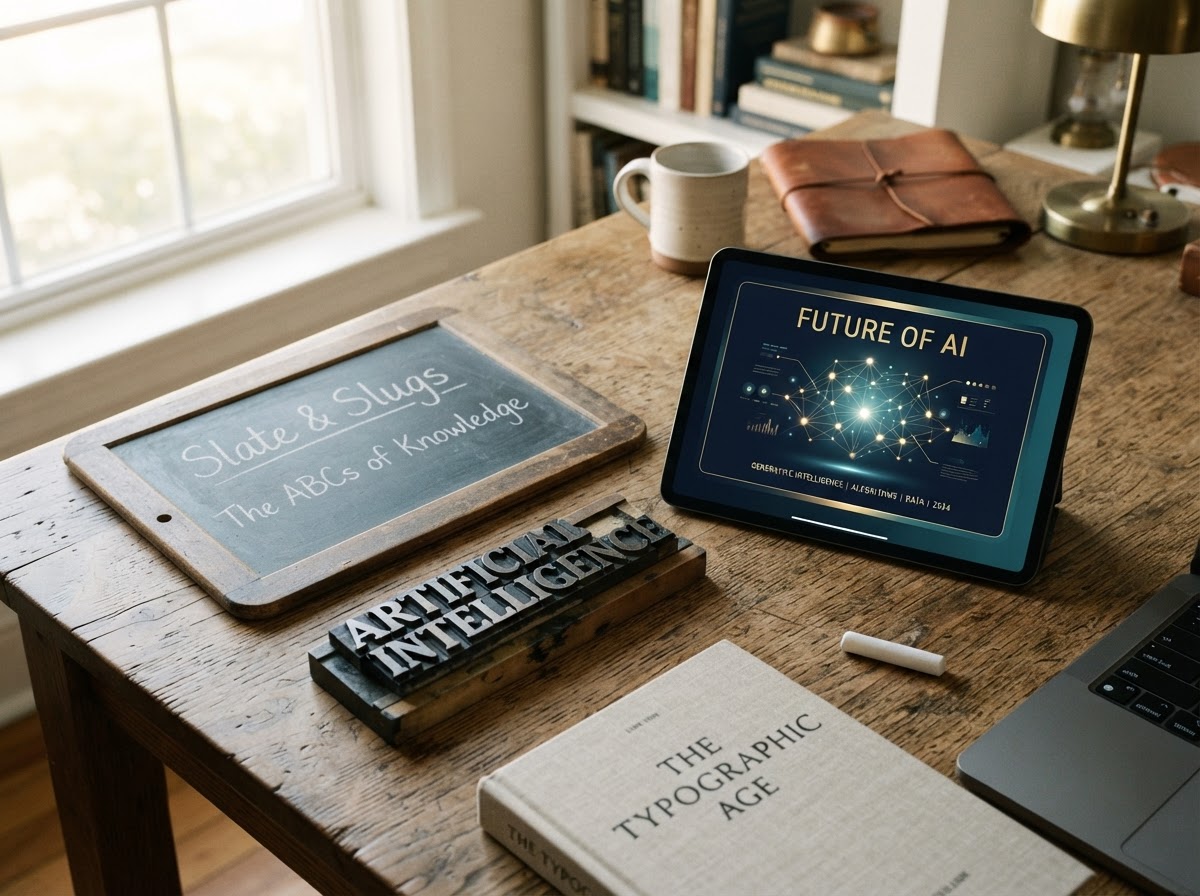
The first technology I remember using to record an idea was a slate.
I was about five years old, growing up in Belize in the 1960s, and my job was not particularly complicated: learn my ABCs, learn my numbers, and learn to write my name.
My first teacher was Miss Elliott. She had taught my mother before me and my oldest brother, Hugh, too. Eventually, at least three children from our family would pass through her school. There were more than 11 of us altogether—10 brothers and sisters and me—and ours was not a family with an abundance of financial resources. But we learned. We worked. We found our way.
And I wrote.
First, on that slate.
I can still remember the physicality of it: making the marks, erasing everything, and then trying again. Information was something you created with your hand.
One day, Miss Elliott handed me several ballpoint pens that had stopped writing.
“Make these work,” she told me.
So I shook them– I shook and shook those pens, trying to get the ink moving down the refills. Eventually, they began to write again.
For my trouble, Miss Elliott gave me one.
And… that was my first pen.
I couldn't possibly have understood it then, but I had just moved from one information technology to another. And I have been doing that ever since.
When Words Had Weight
By my teenage years, I had become attached to my disposable refill blue Parker pens.
There was something special about the way they moved: As the ink flowed onto the paper, ideas seemed to flow with it. My mind would just move along. One thought would awaken another. What had existed invisibly inside my head suddenly became something I could see, rearrange, and share.
Writing became more than a school activity.
It became a way of thinking.
But another education was happening simultaneously. Because my family did not have much money, working while young was simply part of life. I found a job at a print shop in Belize, initially as a messenger and general assistant.
That print shop would become the first university I attended.
I worked in the darkroom. I learned the bindery. I operated large offset presses and high-speed letterpresses. I was learning the different stages through which an idea had to travel before it became something another human being could hold.
And, I loved it. I particularly loved to help out the guy who ran the “Linotype.
For someone growing up with a smartphone, it is difficult to communicate just how physical information once was.
The Llinotype machine did not merely display words. It helped transform lines of type into metal slugs. Those pieces of metal could then become part of the machinery through which ink met paper.
Words had weight.
Information occupied space.
In other words, an error was not something you always corrected by pressing Backspace.
A published page represented an astonishing choreography of human judgment, machinery, materials, specialized skills, time, and physical labor.
And, like I already said, I loved it!
The Magazine That Changed My Direction
The print shop also sent me into the world.
As a messenger, I encountered businesspeople and organizations throughout Belize. I was but a teenager being exposed to people doing things I had not previously imagined myself doing.
Then a traveling couple arrived in Belize...
As I remember it… they were Canadians—I recall Calgary. They were on an extraordinary journey south, through the Americas with a recreational vehicle, dirt bikes, and another vehicle (A Bronco, I recall) accompanying them. Along the way, they told me, they were stopping in every country between the USA and the end of South America, producing local magazines for each of the countries they encountered.
I worked on the magazine they produced about Belize.
I was fascinated.
Here were people traveling our part of the world, observing it, turning what they discovered into words and images, and creating something other people could read.
I asked questions.
And something clicked.
By the age of 17, I published my own magazine.
Prior to that, I had thought of myself largely as a mathematics-and-science person. My parents imagined a respectable scientific profession for me—what we then commonly called a druggist, what today we would call a pharmacist.
Instead, somewhere among the Parker pen, the presses, the metal type, the many writers and publishers, and that first magazine, another identity emerged.
I became a writer.
I have been one ever since.
The Machines Kept Changing
I eventually left Belize for the United States.
My life expanded. So did the technologies around me.
I worked on another magazine. I joined the United States Air Force and wrote for a base newspaper. I earned a bachelor's degree in English. Eventually I entered corporate America and became a professional communicator, working in environments where complex information had to be understood, organized, and communicated clearly.
The tools kept arriving.
Typewriters gave way to word processors.
Paste-up and physical production gave way to desktop publishing.
The darkroom surrendered territory to digital images.
Files traveled electronically instead of being carried from desk to desk.
Personal computers became ordinary.
The internet arrived.
Search engines transformed research.
Publishing escaped the printing press and moved onto websites, blogs, social networks, and platforms accessible from almost anywhere on Earth.
Over a career spanning decades, I worked with organizations including the U.S. Air Force, Chevron, Honeywell and AlliedSignal, Southern California Edison, and Saudi Aramco. I wrote technical and business material, manuals and marketing communications. I worked with increasingly sophisticated software for publishing, documentation, diagrams, and information management.
I kept learning the newest tools because that was what I had always done.
From slate.
To pen.
To type.
To press.
To computer.
To internet.
Each transition seemed remarkable when it arrived.
Yet artificial intelligence feels different.
The Tool That Answers Back
A printing press could multiply my words.
A word processor could make them easier to revise.
A computer could store them.
The internet could distribute them around the planet.
A search engine could help me find information with astonishing speed.
But none of those technologies could sit on the other side of an unfinished thought and say, in effect:
Have you considered this?
That is the discontinuity.
For the first time in my life, the technology I use to work with information can also participate—imperfectly, certainly—in working on the information with me.
I can present an argument and ask for its weaknesses.
I can bring together ideas scattered across months of thinking and ask for patterns.
I can investigate an unfamiliar subject.
I can explore five alternatives before committing to one.
I can ask questions of my questions.
I can move from an idea to a plan, from a plan to a prototype, from a prototype to a system.
And increasingly, AI systems can do more than converse. They can use tools, work across documents and data, write software, analyze images, and execute portions of complicated workflows.
The machine surrounding the idea is becoming a participant in its development.
That is new.
And after spending a lifetime watching information technology change, I do not use the word new casually.
What Became of the Writer?
There is an obvious anxiety embedded in this development.
If artificial intelligence can write, what becomes of someone who has spent his life writing?
It is a reasonable question.
But it may be the wrong one.
When desktop publishing arrived, my value was not that I alone could manipulate type.
When search engines arrived, my value was not that I personally possessed every fact I needed.
When spell-check arrived, my value was not that I could catch every misspelled word without assistance.
Technology repeatedly absorbed portions of the process.
The human contribution moved.
AI is doing this again, but at a far greater scale.
I find myself doing something today that I could not have adequately described when I was that boy at the print shop.
I am orchestrating intelligence.
I am deciding what I want to accomplish. Supplying context. Asking questions. Evaluating answers. Rejecting weak directions. Connecting ideas. Applying experience. Setting standards. Correcting errors. Choosing what matters. Bringing different capabilities together around an intended outcome.
Writing remains part of it.
But writing is no longer always the entire job.
Sometimes I feel less like the person playing every instrument and more like the person conducting the orchestra.
That is not a diminishment of the human role.
It can be an enlargement of it.
The Renaissance Person Returns
There is a strange historical irony here.
For centuries, the Renaissance ideal celebrated the person who could move across disciplines—the artist who studied anatomy, the scientist who drew, the engineer who philosophized.
Modern civilization moved increasingly toward specialization. Our knowledge became so vast and our institutions so complicated that becoming highly capable often meant becoming highly specialized.
AI may complicate that trajectory.
A single person can now reach into domains that previously required an entire collection of specialists—not because that person suddenly possesses all of their expertise, and certainly not because expertise no longer matters, but because intelligent assistance can help bridge some of the distance between intention and capability.
The writer can prototype.
The entrepreneur can research.
The teacher can design.
The engineer can communicate.
The retiree can build.
The teenager with an idea can begin somewhere that previously required money, staff, credentials, or institutional access.
There are obvious dangers in overstating this. AI can be confidently wrong. Expertise remains indispensable when consequences are serious. Judgment cannot simply be outsourced because an answer arrives in polished prose.
But used well, these systems can expand the radius of what one human being can attempt.
That possibility feels deeply personal to me.
Because in an odd way, much of my life seems to have been preparing me for it.
The Preparation We Couldn't See
The boy learning letters on a slate was learning to communicate.
The child shaking Miss Elliott's pens was learning that tools sometimes need human intervention before they become useful.
The teenager with the Parker pen was discovering the relationship between thinking and writing.
The print-shop worker was learning that every finished product conceals a system.
The messenger was discovering that the world was larger than the circumstances into which he was born.
The 17-year-old magazine publisher was learning that an idea could become an artifact.
The airman writing for a newspaper was improving his ability to communicate to an audience.
The technical communicator was learning to transform complexity into clarity.
The corporate professional was learning that information may have to move through people, organizations, processes, technologies, and decisions before it creates value.
The writer was learning to ask what he wanted to say.
And the human being—through successes, failures, responsibilities, disappointments, personal struggles, and decades of ordinary life—was accumulating something no new software installation could provide:
Context.
Now all of it arrives at the same desk.
And artificial intelligence arrives there too.
Perhaps that is one of the great misunderstandings of this moment. We tend to imagine AI adoption as though we have to begin at zero: Here is the new technology; now learn it.
But none of us begins at zero.
We arrive carrying entire lives.
The accountant may bring 30 years of understanding businesses.
The nurse brings thousands of encounters with sick patients.
The mechanic brings an intuition for machines that no manual fully captures.
The teacher brings memories of the child who finally understood.
The entrepreneur brings failures.
The immigrant brings multiple worlds.
The 60-year-old brings things the 25-year-old cannot yet possess. On the other hand, the 25-year-old can bring perspectives and fluencies the 60-year-old may need to learn.
AI meets all of that.
The interesting question is what happens next.
From Operator to Orchestrator
I sometimes think back to that print shop, located not more than a few steps from our own home in Kings Park, Belize City. .
To create a publication, many things had to work together: words, type, photographs, slugs, galleys, plates, ink, paper, machines, binding, people.
No single component was the publication.
The outcome emerged from the system.
Maybe deep down, that's how the idea of orchestration came to feel so natural to my writing books and now everything else.
AI gives us another collection of capabilities—some already extraordinary, others immature, all evolving.
The challenge is not simply to “use AI.” It is to learn what should be done by the machine, what should remain with the human, where judgment enters, where verification is required, what outcome you're pursuing, and whether that outcome deserves pursuing at all.
The human being becomes less merely an operator of a tool and more a director of capabilities.
That is why I am not particularly interested in becoming the world's greatest prompt writer.
Prompts will change.
Interfaces will change.
Models will change.
The deeper capability is learning to direct intelligence toward meaningful outcomes.
The Slate Is Still Here
I sometimes wonder what Miss Elliott would make of all this. Me, Karen, David and all of us little ones sitting under her gaze, trying to form letters on our slates.
Almost six decades later, those of us that are still here can sit before a machine containing access to more information than the largest libraries of our childhood and engage an artificial intelligence in developing our ideas.
The distance between 1963 and 2028 seems almost absurd.
And yet something connects the two eras.
The technology changed.
The human intention did not.
I was trying to make something appear outside myself.
A letter.
A number.
A name.
A magazine.
A newspaper story.
A manual.
A book.
An idea.
A contribution.
What Have You Been Working On?
Artificial intelligence may be the most powerful technology we have encountered in our lifetime.
It has begun to alter our work, education, creativity, organizations, and human identity in ways we are only beginning to understand.
But I do not look at it and see the end of the human story.
I see an extraordinary new chapter in it.
For people who have been here for a little while, there may be a temptation to look at AI as though it belongs to somebody else's future.
I believe the opposite.
Everything you have lived may be part of what prepares you to use AI today.
Your expertise matters.
Your failures matter.
Your curiosity matters.
Your values matter.
Your judgment matters.
Your understanding of other human beings matters.
Your life is not obsolete simply because a machine has become intelligent.
I believe it is the very thing that tells us what all that intelligence is for.
I began with a slate.
Then came the pen.
Then the slugs.
Then the presses, computers, software, networks, search engines, and a world of information increasingly available at the sound of my voice.
Now comes artificial intelligence.
And after a lifetime spent learning how to operate the machines of information, I find myself facing something I never expected:
A machine that can help operate on information with me.
So I will do what I have done since I was a boy.
I will learn it. I will question it. I will work with it. I will make it useful.
And this time, instead of merely operating the machinery,
I will continue to conduct the orchestra.