IDEAS
Productivity Isn’t the Destination. Contribution Is.
Our ability to produce more is becoming easier. The harder—and more valuable—question is what all that increased capability should be used to create.
By Eugene L. Morrison

For most of modern working life, productivity has been treated as an unquestioned good.
Produce more. Do it faster. Reduce the cost. Shorten the meeting.
Automate the process. Answer more emails. Write more reports. Serve more customers. Make more things in fewer hours.
Entire industries have been built around helping us squeeze more output from the same finite container: a day.
Artificial intelligence is now blowing a hole through that container.
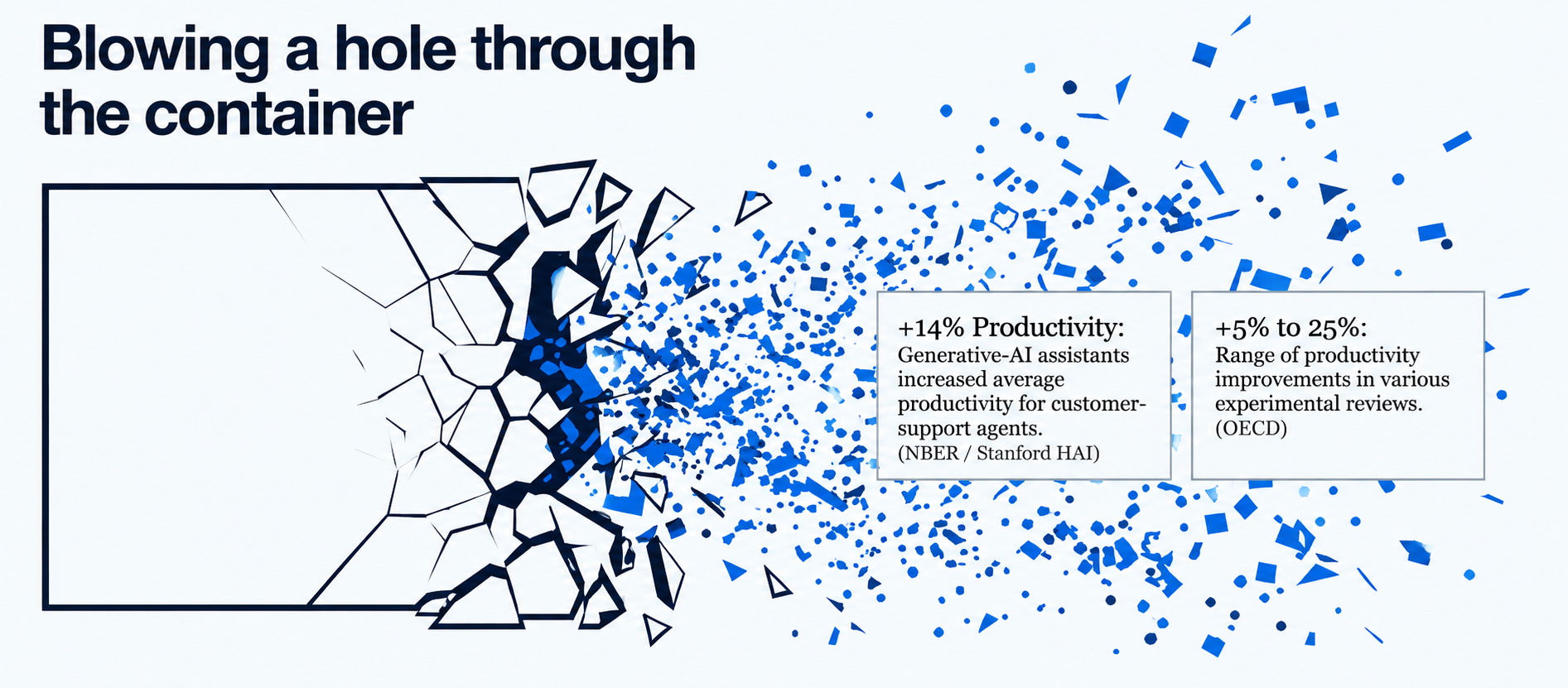
A professional today can begin the morning with a blank page and end it with a report, a presentation, a marketing campaign, an analysis of a spreadsheet, a prototype of an application, and the outlines of a business plan. Work that once required days can sometimes be accomplished in hours. Work that required a team can now be attempted by an individual.
This isn't merely anecdotal. Researchers studying more than 5,000 customer-support agents found that access to a generative-AI assistant increased productivity by 14 percent on average, with much larger gains among less experienced workers.
A separate randomized experiment involving more than 6,000 knowledge workers found that people using generative AI spent less time on email and completed documents faster. The OECD's review of experimental evidence reports productivity improvements ranging from 5 percent to more than 25 percent in some kinds of work. National Bureau of Economic Research
The 2026 Stanford AI Index summarizes the emerging picture: AI's productivity gains appear strongest in structured work with measurable outputs and clear feedback. Stanford HAI
These are significant developments.
But they also lead us toward a question we have spent surprisingly little time asking.
What is all this productivity for?
When Production Becomes Abundant
For generations, producing something worthwhile required friction.
Writing required time. Research required searching. Design required specialized skill. Software required programmers. Analysis required analysts. A small business that wanted the capabilities of a large company often had to hire the people who possessed them.
That friction is now disappearing. Expertise still matters enormously. But AI is reducing the distance between an intention and a plausible first outcome.
You can see the beginnings of this shift in how people already use these systems.
Microsoft's analysis of 200,000 anonymized Copilot conversations found people frequently turning to AI for information gathering and writing, while AI itself commonly performed activities involving information, writing, teaching, and advising.
Anthropic's early Economic Index similarly found AI being used both to automate work and—somewhat more frequently in its initial data—to augment human capability. Microsoft
The International Labour Organization estimates that one in four workers globally now works in an occupation with some degree of exposure to generative AI. Its researchers emphasize that transformation, rather than outright replacement, remains the more likely near-term consequence for most jobs. International Labour Organization
In other words, the interesting story may not simply be that machines are becoming capable.
It is that people with machines are becoming capable of doing things they previously could not do—or could not do nearly as easily.
That is a very different proposition.
And it changes the question.
When production is difficult, productivity is an obvious objective.
When production becomes increasingly abundant, selection becomes more important.
What deserves to be produced?
The Productivity Trap
Imagine that AI allows you to write 20 articles in the time it once took you to write two.
Have you become ten times more valuable?
Maybe.
Or perhaps you have simply created 18 additional articles the world didn't need.
Suppose a company uses AI to produce five times as much marketing content.

Is that success?
It might be. But if customers are now drowning in machine-generated emails, advertisements, social posts, and personalized solicitations, the organization may have increased its output while decreasing the value of each additional unit of attention it consumes.
A manager can generate more reports. A consultant can make more presentations. A teacher can produce more lesson plans. A programmer can generate more code. A creator can publish more content.
The important question today is no longer merely whether we can.
It is whether we should.
There is already evidence that the productivity story is more complicated than the slogans surrounding AI suggest. In one randomized trial, experienced open-source developers working on repositories they knew well took 19 percent longer to complete tasks when allowed to use early-2025 AI tools—even though they believed AI had made them faster. The researchers appropriately caution against generalizing the result to all software development, but the discrepancy between perceived and measured productivity is instructive. METR
And speed can carry subtler costs.
Microsoft researchers studying 319 knowledge workers found that greater confidence in generative AI was associated with less reported critical thinking. Their work suggests that as AI assumes more of the production process, human cognitive effort can shift toward verification, integration, and stewardship.
Microsoft researchers have consequently been exploring a different conception of AI: not merely as a machine for producing answers, but as a tool for thought—something capable of challenging assumptions and deepening human reasoning. Microsoft
That distinction matters.
Because a civilization capable of generating more answers does not necessarily become a civilization capable of asking better questions.
From Productivity to Contribution
Perhaps we need a different measure.
Contribution.
Productivity asks:
How much did you produce?
Contribution asks:
What became better because you produced it?
Productivity counts the report.
Contribution asks whether the report changed a decision.
Productivity counts the software.
Contribution asks whether the software solved a meaningful problem.
Productivity counts the lesson.
Contribution asks whether somebody learned.
Productivity counts the medical analysis.
Contribution asks whether it helped a clinician make a better decision.
Productivity counts the business plan.
Contribution asks whether someone built a business worth having.
This is not an argument against productivity. Productivity matters. Economic growth matters. Efficiency matters. Wasted human effort is not noble simply because it is human.
But productivity is a means.
Contribution is closer to an end.
That distinction becomes more important precisely because AI makes production easier.
If I have one hour and can produce only one thing, scarcity forces selection upon me. If AI allows me to produce 100 things, the burden of selection moves back onto my shoulders.
Abundant capability increases the importance of human judgment.
The Human Job Is Moving
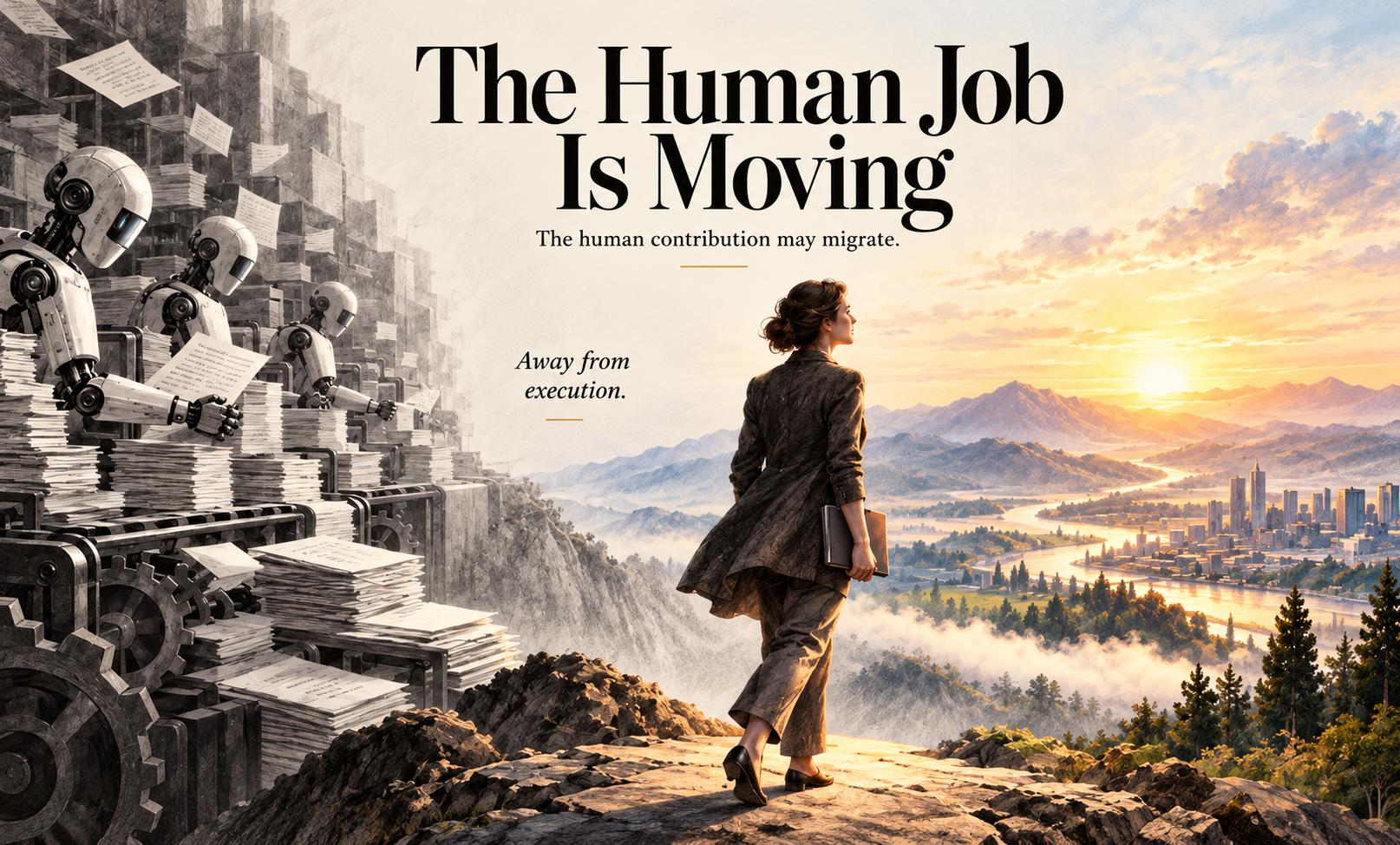
Much of the conversation about artificial intelligence has focused on a contest: Which tasks will machines take from humans?
There is another way to look at it.
As machines become more capable, the human contribution may migrate.
Away from some forms of execution and toward:
purpose, judgment, direction, context, standards, responsibility, and meaning.
Consider navigation.
For most of human history, reaching a distant destination required considerable navigational ability. Today, a phone can calculate the route, monitor traffic, reroute around an accident, estimate arrival time, and speak every turn aloud.
Navigation became abundant.
But Google Maps cannot tell you where your life should go.
When navigation becomes abundant, destination selection becomes more important.
AI may be creating an analogous change in intellectual and creative work.
It can increasingly help us figure out how.
That makes it more important for humans to decide what—and why.
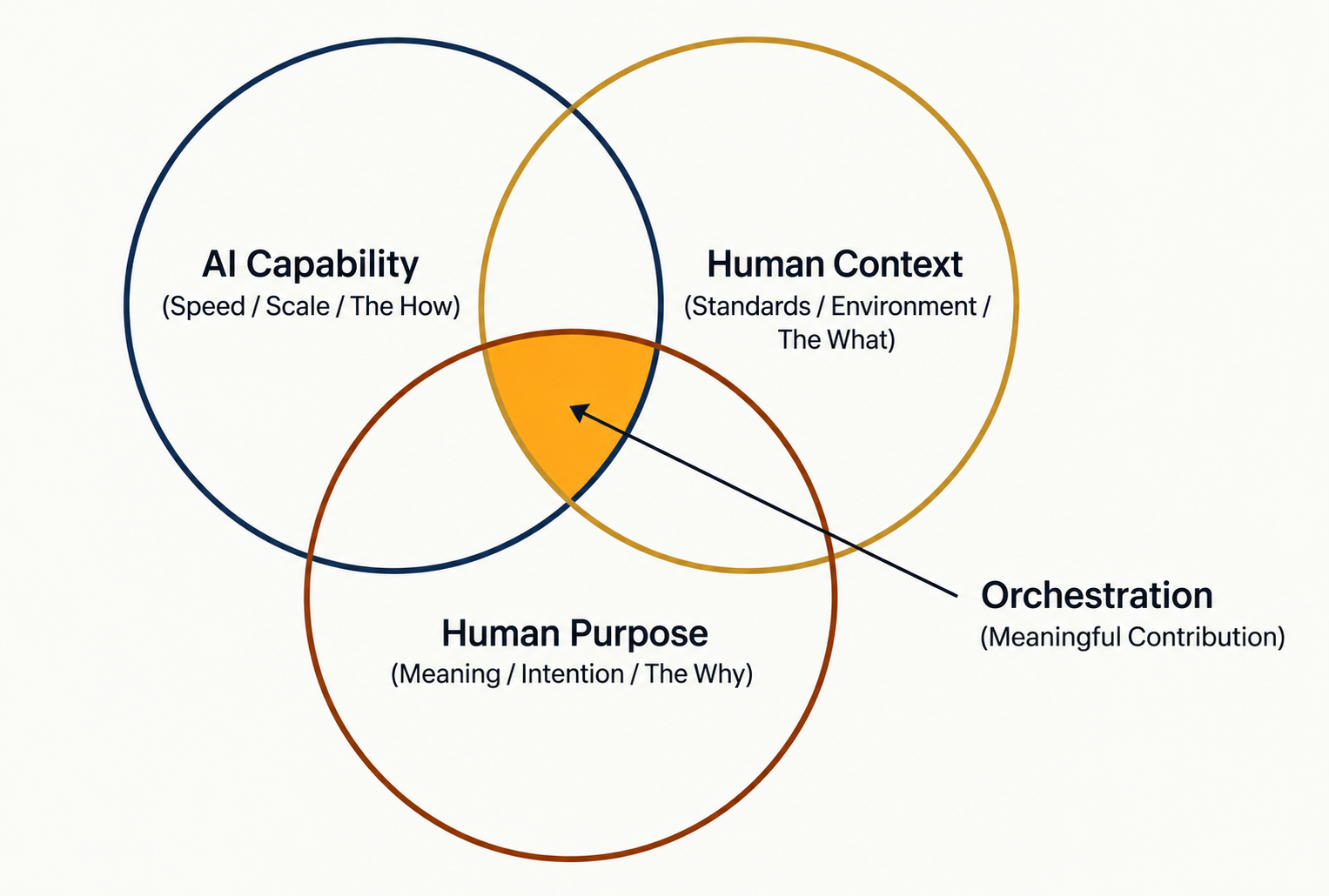
This is why the highest form of Human-AI collaboration may not be delegation. It may be orchestration: the ability to direct different forms of intelligence, tools, workflows, systems, and human judgment toward an outcome worth creating. Consider the following diagram.
The human does not disappear from that system.
The human moves closer to its center.
The Dangerous Ease of Making Things
There is an uncomfortable possibility embedded in the AI revolution.
We may become extraordinarily good at producing things that do not matter.
We can already generate emails nobody wants to read, articles nobody asked for, images nobody remembers, reports nobody uses, applications nobody needs, meetings summarized for people who perhaps should not have attended them in the first place.
AI did not invent meaningless work.
It may simply make meaningless work astonishingly scalable.
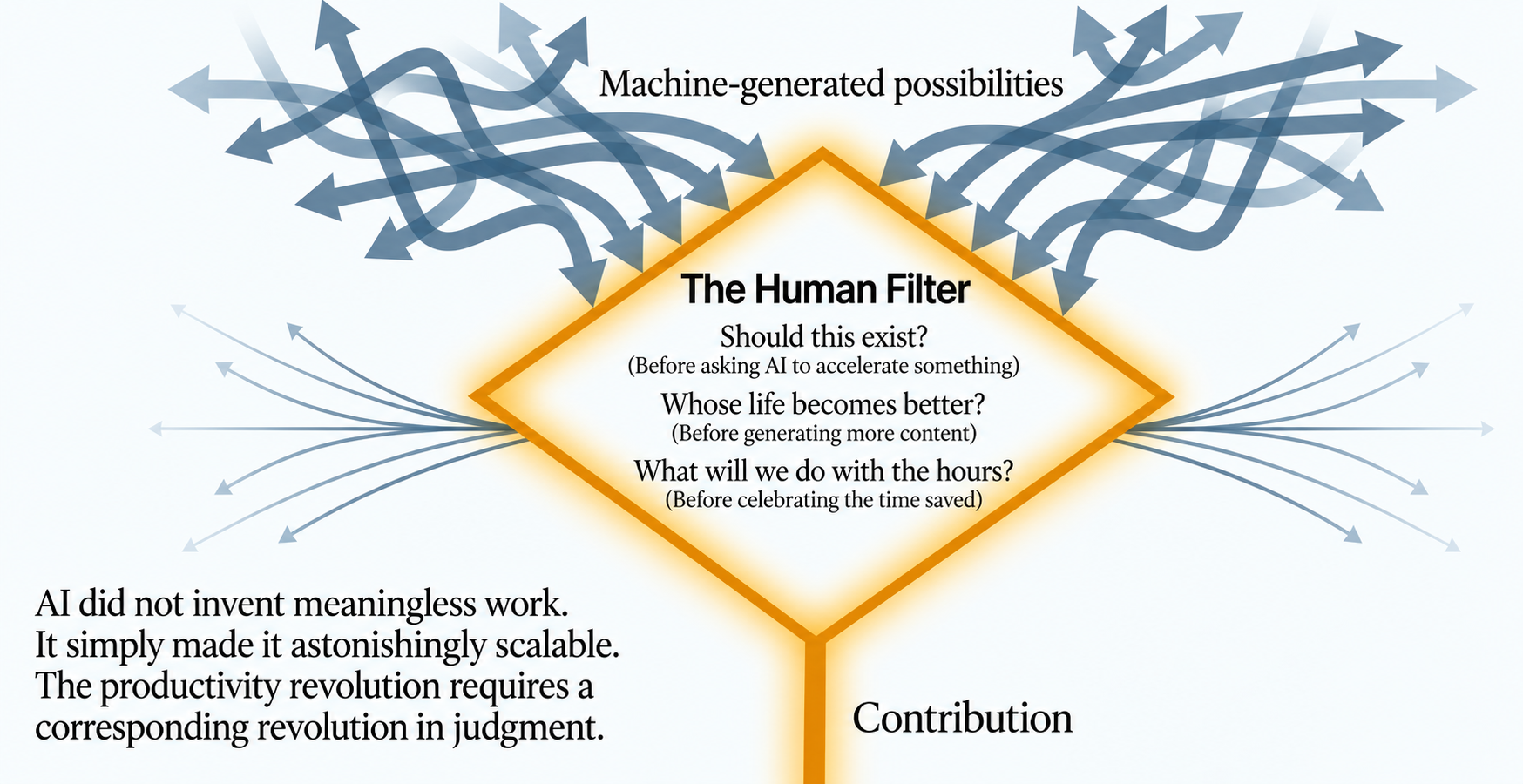
That is why the emerging productivity revolution requires a corresponding revolution in judgment.
Before asking AI to accelerate something, we may need to ask:
Should this exist?
Before automating a process:
Should this process continue to exist?
Before generating more content:
Whose life becomes better because this content exists?
Before celebrating the hours saved:
What will we do with those hours?
These are not technical questions.
They are human ones.
The Return of Intention
I have spent much of my life working with words and information.
I learned my ABCs on a slate. As a teenager in Belize, I worked around letterpress printing, where words became physical pieces of metal—slugs of type that had to be arranged before ink ever touched paper.
Producing information had weight.
It took lots of heavy machinery, specialized materials, craft, and time.
Today, I can sit before a computer and collaborate with artificial intelligence to explore, draft, challenge, restructure, and develop an idea at a speed my younger self could scarcely have imagined.
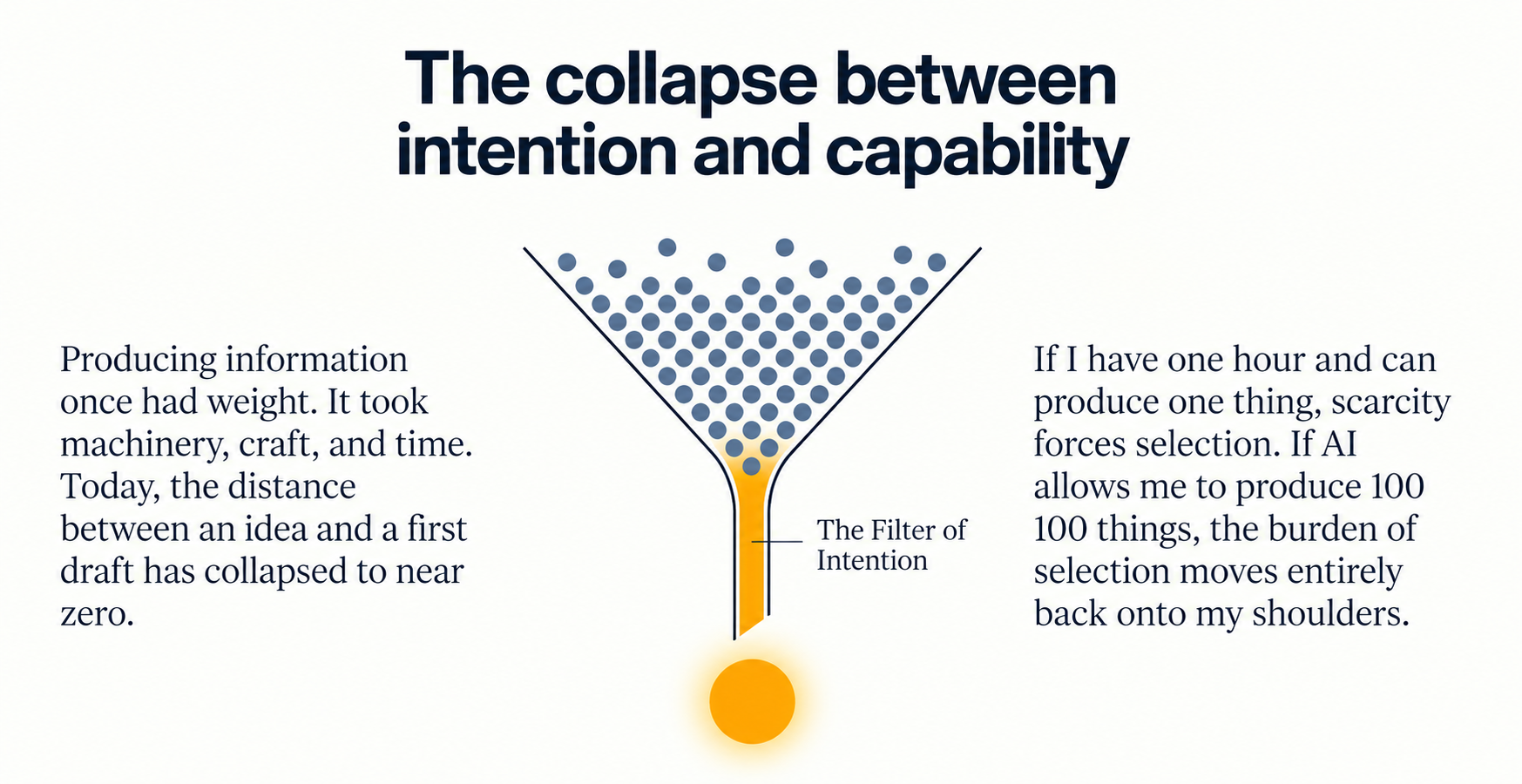
The distance between intention and capability has collapsed.
And that makes intention more consequential, not less.
The important question is no longer simply, What can this machine produce for me?
It often has bedome:
What am I trying to contribute through it?
That question applies to a 25-year-old programmer, my 80-year-old doctor friend, an executive, an entrepreneur building her first company, a teacher preparing tomorrow's lesson, a writer staring at a blank page, or someone who has never considered himself particularly technological.
AI gives each of them new possibilities.
It does not supply the purpose for which those possibilities should be used.
A More Capable Human

We are still early enough in the AI era that much of our attention is understandably fixed on the tool capability.
What can the newest model do?
How fast is it?
How much does it cost?
Which benchmark did it beat?
What can it automate?
Those questions matter.
But eventually another question has to enter the conversation:
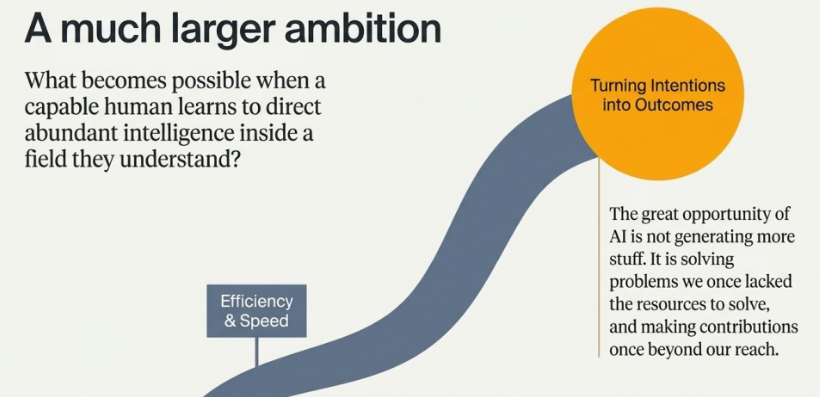
What becomes possible when a capable human learns to direct abundant intelligence inside a field that person understands?
That may prove to be one of the defining questions of this era.
Not because productivity will cease to matter. Quite the opposite. We may become more productive than previous generations could reasonably imagine.
But the great opportunity of artificial intelligence is not that it allows humanity to generate more stuff.
It is that it may allow more people to turn intentions into outcomes—to solve problems they once lacked the resources to solve, create things they once lacked the skills to create, explore ideas they once lacked the time to explore, and make contributions once beyond their reach.
In other words, the human becoming more capable!
That is a much larger ambition than efficiency.
So yes, let us use AI to save time.
Let us automate drudgery.
Let us write faster, analyze faster, prototype faster, learn faster, and build faster.
But after all that acceleration, one question will remain waiting for us:
Toward what?
Because productivity isn't the destination.
PART 2
Who you become and contribute are more important.