IDEAS
What Happens to Human Value When Intelligence Becomes Abundant?
When access to intelligence stops being the primary constraint, purpose, judgment, and direction begin to matter differently.
By Eugene L. Morrison

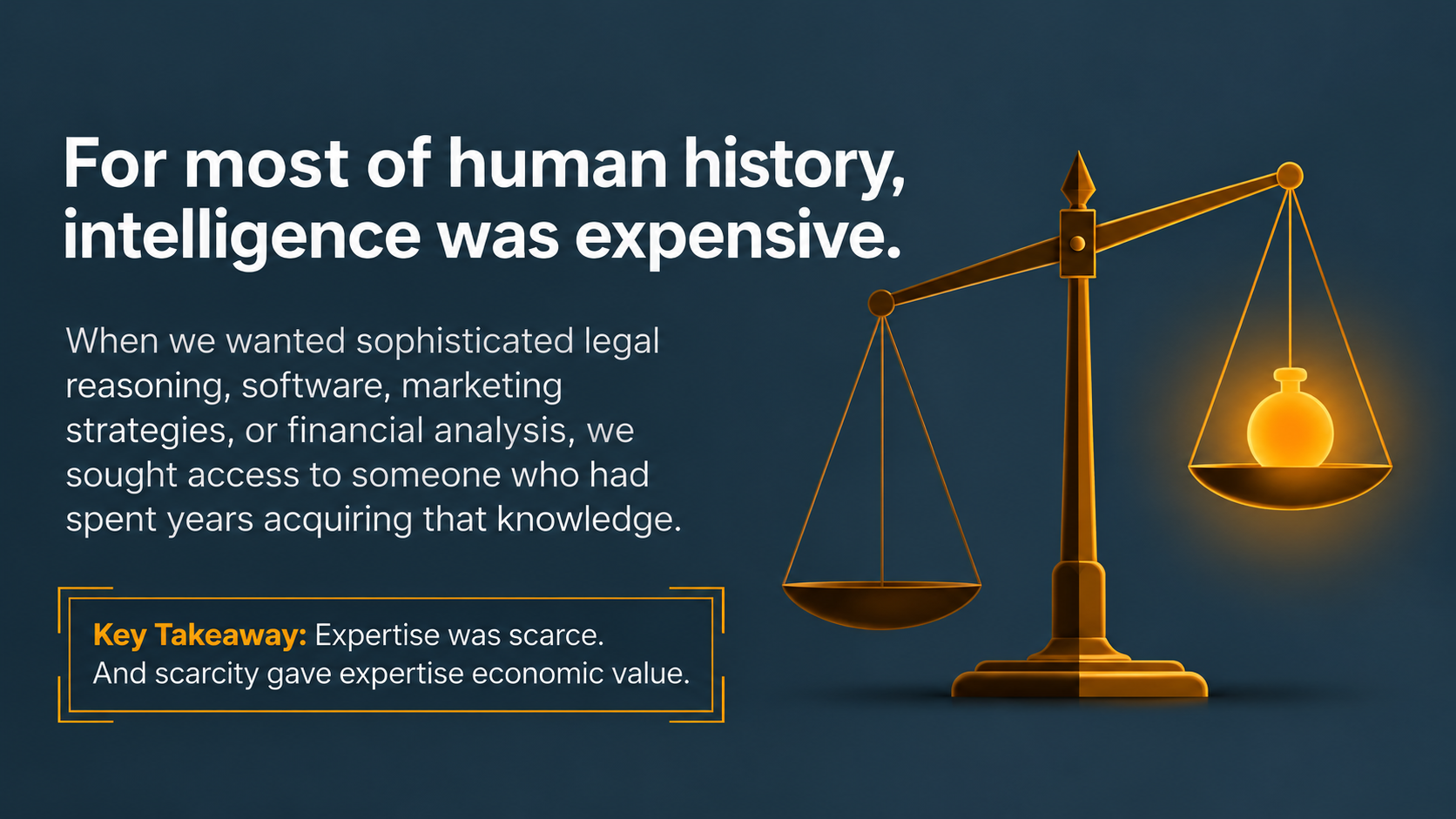
For most of human history, intelligence was expensive.
When we wanted sophisticated legal reasoning, we went to see a lawyer. If we wanted software, we needed programmers. When we needed a new marketing strategy, financial analysis, engineering plan, research report, or professional illustration, we generally seeked access to someone who had spent years acquiring the necessary knowledge.
Expertise was scarce. And scarcity gave expertise economic value.
But, we’re now in the AI age and Artificial intelligence is beginning to disturb that arrangement.
Today, a person sitting alone at a laptop can summon assistance with writing, research, analysis, coding, strategy, design, tutoring, translation, planning, and increasingly complex sequences of work.
The assistance is imperfect. It can hallucinate, misunderstand context, reinforce bad assumptions, and produce work that merely looks authoritative. Human expertise still matters enormously.
But something fundamental has nevertheless changed.
Useful intelligence is becoming dramatically easier to access.

Stanford’s 2026 AI Index reports that generative AI reached nearly 53 percent adoption within three years—faster than either the personal computer or the internet—and that organizational AI adoption continued rising in 2025.
At the technical frontier, AI performance is advancing so quickly that some benchmarks designed to challenge models are becoming saturated within months. Stanford HAI
That creates an unsettling question.
If intelligence was one of the things that made human beings economically valuable, what happens to human value when intelligence becomes abundant?
The Wrong Conclusion
One answer, increasingly common in public conversation, is that human beings simply become less valuable.
If machines can write, code, analyze, reason, illustrate, advise, and plan, then surely the economic logic is straightforward: machines gain value; humans lose it.
There will unquestionably be disruption. A recent Stanford’s AI Index finds labor-market effects appearing unevenly, including pressure on hiring pipelines and younger workers in some AI-exposed occupations.
At the same time, large-scale job losses attributable to AI have not yet appeared in overall employment data, even as a third of organizations surveyed said they expected AI to reduce their workforces over the following year. Stanford HAI
So complacency would be foolish.
But so would assuming that human value is simply a fixed quantity being transferred to machines.
Something subtler may be happening.
AI may be changing where human value resides.
Think about calculators.
There was a time when performing complicated calculations quickly was itself a valuable capability. Calculators did not make mathematics worthless. They moved the frontier. Once calculation became easier, greater value could be placed on knowing which calculation mattered, how to formulate a problem, whether the inputs made sense, and what the result meant.
The spreadsheet did something similar.
So did the search engine.
When one capability becomes abundant, value often migrates toward whatever remains scarce around it.
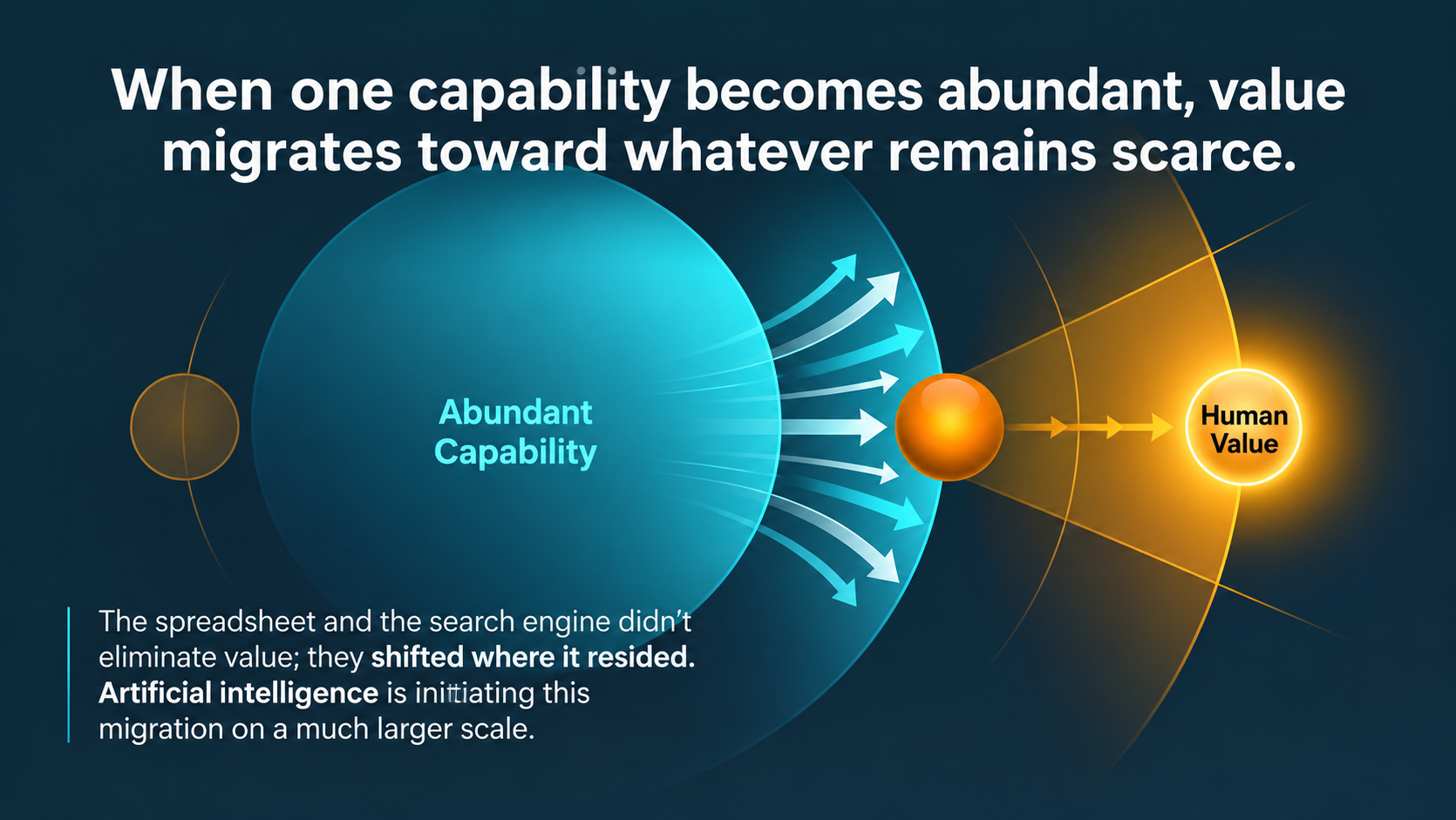
Artificial intelligence may be initiating that migration on a much larger scale. What do you think?
Intelligence and Judgment Are Not the Same Thing
One of our difficulties is linguistic. We tend to bundle many different human abilities into the word intelligence.
But generating possibilities is not the same as choosing among them.
Prediction is not purpose.
Analysis is not responsibility.
An answer is not judgment.
And knowing how to accomplish something is not the same as knowing whether it ought to be accomplished.
This distinction becomes important as AI gets better.
Researchers studying 5,179 customer-service agents found that a generative-AI assistant increased productivity by 14 percent on average, with gains concentrated particularly among less experienced workers.
One interpretation offered by the researchers is that AI helped diffuse the practices of stronger workers throughout the organization. National Bureau of Economic Research
An OECD review of experimental studies likewise found productivity gains ranging from roughly 5 percent to more than 25 percent in tasks including customer service, software development, and consulting. OECD
That is remarkable.
Knowledge that once had to be accumulated through experience can, in certain contexts, increasingly be made available at the moment of need.
But consider what happens next.
Suppose an entrepreneur can generate 50 plausible business ideas this afternoon.
Which one should she pursue?
Suppose an executive can generate 10 strategies for entering a new market.
Which risks are acceptable?
Suppose a physician can receive an AI-generated analysis of an unusually complicated case.
What information deserves greater weight?
Suppose a writer can generate 100 article concepts.
Which one is worth asking another human being to spend ten minutes reading?
The machine’s abundance does not eliminate the decision.
It can increase the burden of deciding.
When Navigation Becomes Abundant
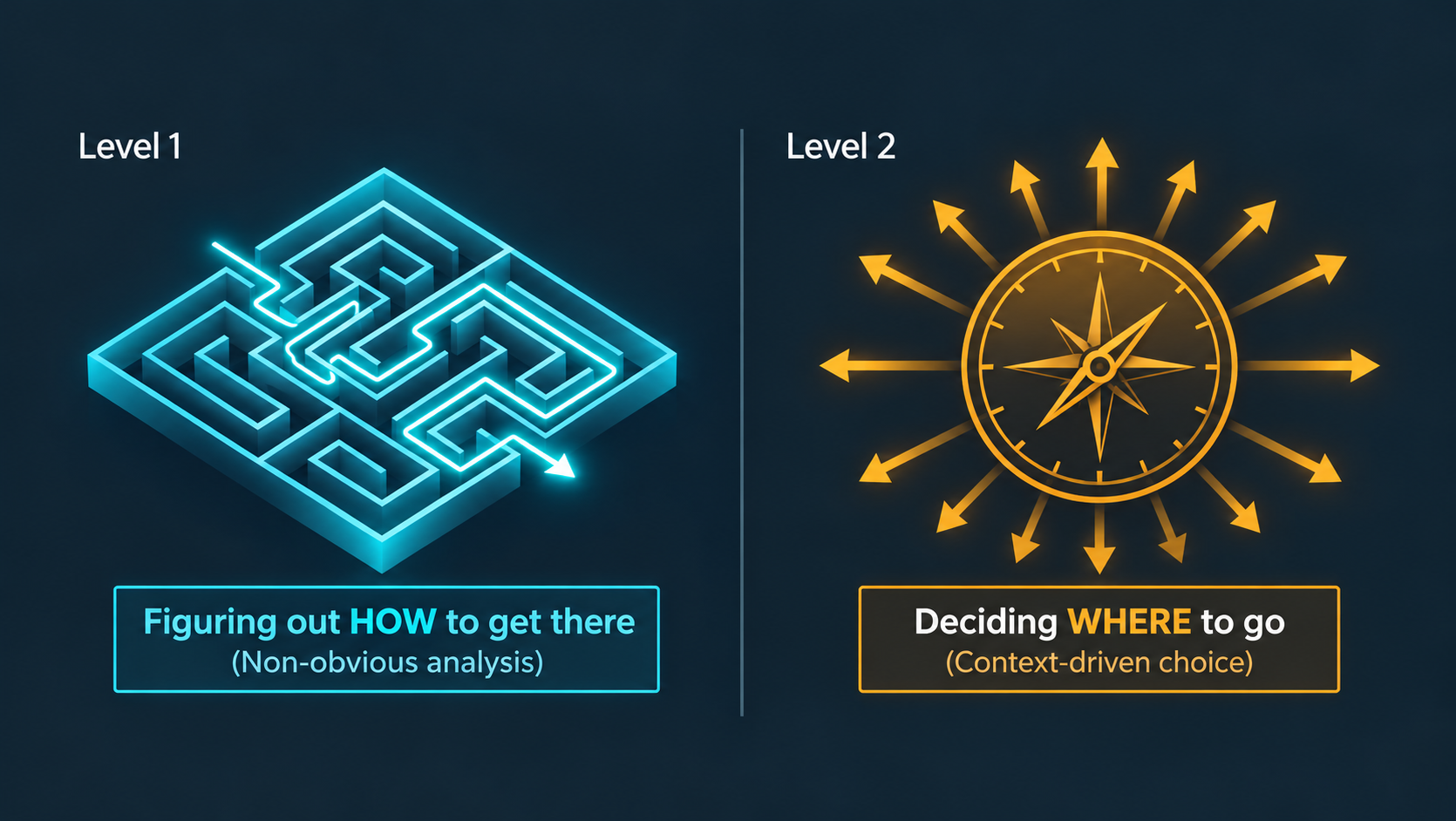
In other articles, I talked about how we have already lived through a simpler version of the GPS transformation.
Not long ago, navigating an unfamiliar city required a particular kind of intelligence. You might study a map, memorize landmarks, ask someone for directions, miss a turn, retrace your route, and gradually construct a mental model of the place.
Today, your phone does almost all of that.
Navigation is now abundant.
But, have you noticed it? GPS has not answered one rather important question:
Where should you go?
The New Scarcity
This points toward a different way of thinking about the AI economy.
Perhaps we should ask not merely what AI makes abundant, but what abundance makes scarce.
Attention is scarce.
Trust is scarce.
Good judgment is scarce.
Deep domain understanding remains scarce.
Original questions are scarce.
Responsibility is scarce.
Meaningful human relationships are scarce.
The ability to distinguish what matters from what merely demands attention is scarce.
And purpose—the ability to decide what all this astonishing capability should ultimately be directed toward—may become more valuable precisely because execution is becoming easier.
Employer surveys already hint at this complementarity. The World Economic Forum’s 2025 Future of Jobs survey found that analytical thinking remained employers’ most frequently identified core skill.
Resilience and flexibility, leadership and social influence, creative thinking, motivation and self-awareness also ranked highly.
AI and big data skills are rising rapidly, but so are several deeply human capabilities. World Economic Forum
The future, in other words, may not belong simply to people who know AI.
It may belong disproportionately to people who know what to do with AI.
The Danger of Cognitive Surrender
There is no guarantee that humans will automatically move upward into judgment, purpose, and direction.
We can also surrender them.
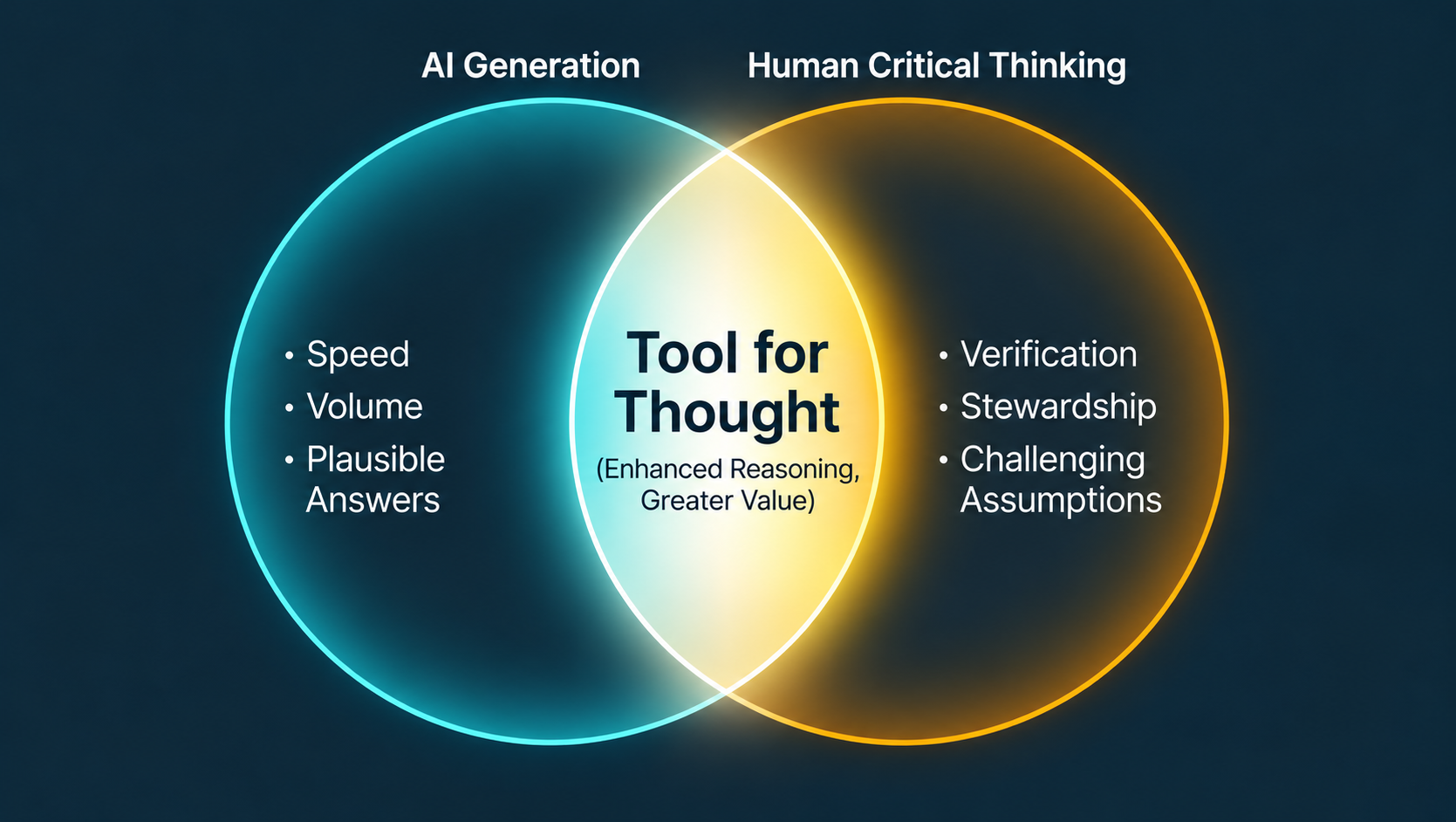
Microsoft researchers surveyed 319 knowledge workers and collected 936 examples of AI use. They found that higher confidence in generative AI was associated with less reported critical thinking, while greater confidence in one’s own abilities was associated with more.
They also observed that critical thinking changes when AI enters the workflow, shifting toward activities such as verification, integration, and stewardship. Microsoft
This is an enormously important warning.
AI can make a person more capable without necessarily making that person a more capable thinker.
Those are not the same thing.
Imagine two professionals using identical AI systems.
The first asks the machine what to think, accepts the answer, polishes it, and passes it along.
The second uses the machine to challenge assumptions, explore alternatives, test arguments, discover missing information, and improve a decision that she remains responsible for making.
Both are “using AI.”
Their relationship to intelligence is entirely different.
Microsoft researchers have begun describing this alternative explicitly: AI not merely as an assistant that produces things for us, but as a tool for thought that can help deepen human reasoning. Microsoft
That distinction may eventually matter more than prompt-writing prowess.
From Producer to Director
For much of industrial history, human value has been closely associated with production.
You made the thing. You wrote the thing. You calculated the thing. You designed the thing. You assembled the thing.
AI complicates that identity because increasingly you may not personally execute every component of the final result.
But consider an orchestra conductor.
The conductor does not play the violin, trumpet, cello, flute, and percussion simultaneously.
Her value does not derive from personally producing every sound.
Her value lies partly in understanding the whole: timing, interpretation, standards, relationships, direction—and in coordinating specialized capabilities toward an outcome none would produce independently.
Something similar is emerging in Human-AI work.
The human contribution begins moving from execution alone toward:
Purpose.
Context.
Questions.
Judgment.
Standards.
Integration.
Responsibility.
Direction.
Orchestration.
This does not make human beings less important. What it is doing is to make a certain kind of human capability more important.
Anthropic’s 2026 Economic Index offers an intriguing glimpse of this transition. In its survey data, large majorities of Claude users reported gains in the speed, scope, and quality of their work; 57 percent also reported that AI had made their own skills more valuable.
Anthropic appropriately cautions that these are self-reports, not objective measures of labor-market value, and that they cannot rule out skill erosion. Anthropic
That ambiguity is precisely the point.
AI can amplify capability.
Whether it amplifies human value depends partly on what the human brings to the relationship.
The Person Who Knows What Matters

I have lived through enough technological change to recognize how strange the present moment is.
I learned my earliest letters on a slate. As a teenager in Belize, I worked around printing technology in which words would become physical pieces of metal. Since then, I’ve spent decades working professionally with words and information.
For much of that journey, producing sophisticated intellectual work required access—to information, machinery, institutions, specialized people, or time.
Today, any of us can sit at a computer and converse with a form of intelligence capable of helping us investigate an idea, challenge an argument, examine research, reorganize a structure, explore alternatives, and turn our intention into something tangible at extraordinary speed.
That does not make our intention less important. I think, it makes it more important.
Because when almost anyone can generate something, generating something is no longer enough.
The question becomes:
That is a different conception of human value.
Not human as the fastest processor.
Not human as the largest repository of information.
Not even human as the sole source of ideas.
How about human as the source of purposeful direction?
A More Capable Human
We are accustomed to asking whether artificial intelligence will become more capable than we are.
There is another question worth asking:
What happens when it makes us more capable than we were?
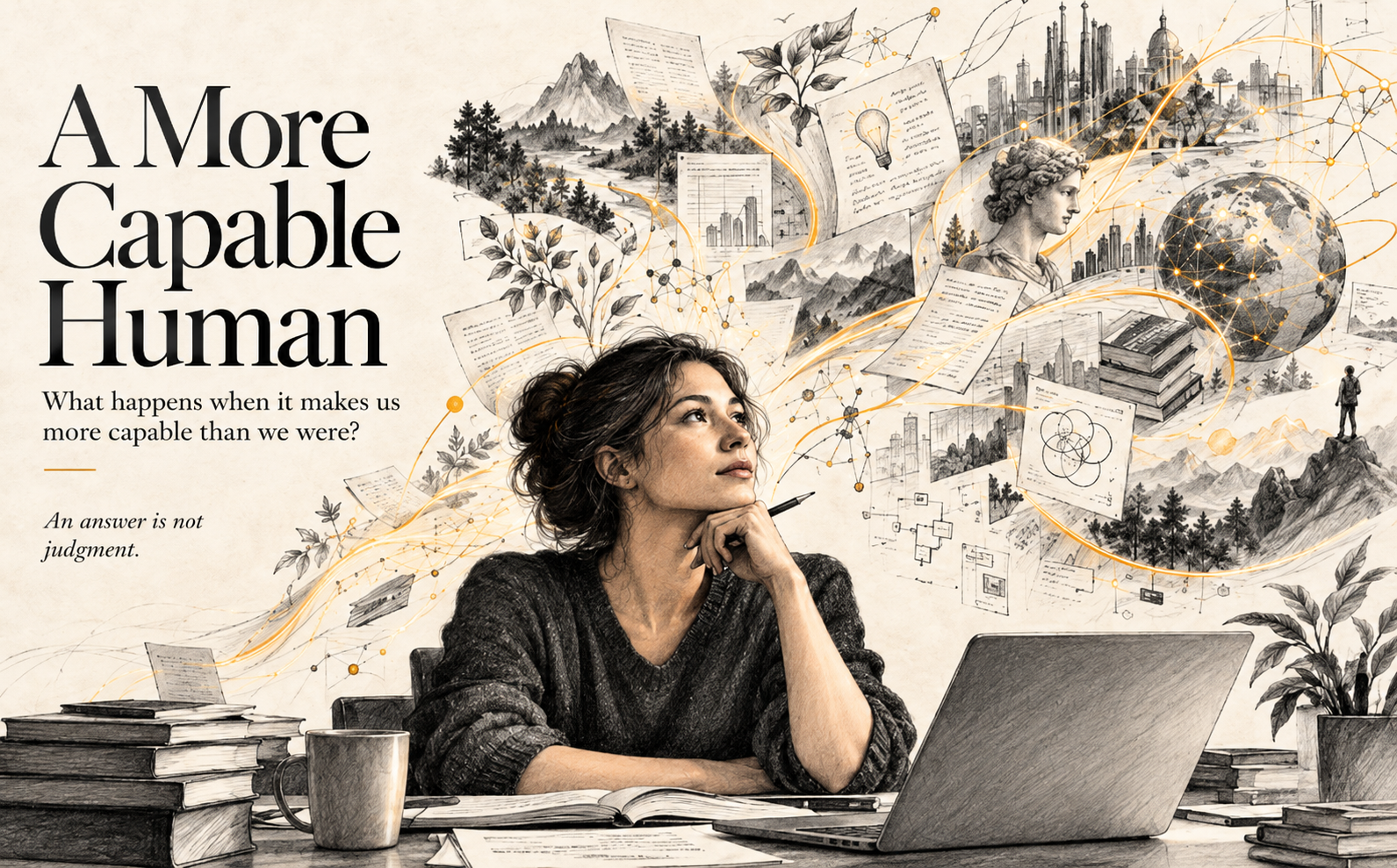
That possibility deserves considerably more attention.
A teacher with greater capability can educate differently.
A small entrepreneur with greater capability can attempt what once required an organization.
A scientist can investigate more possibilities.
A writer can explore more deeply.
A community organization can gain capabilities it could never afford.
A person with an idea but without a staff, technical department, research team, or large amount of capital may be able to cross distances that previously stopped them.
That is not the disappearance of human value.
It is potentially an expansion of our human agency.
But only if we learn to distinguish access to intelligence from mastery of ourselves.
The machines may increasingly supply answers.
We will still have to decide which questions deserve our lives.
The machines may increasingly reveal possible routes.
We will still have to choose destinations.
They may help us build faster than human beings have ever built before.
We will still have to decide what is worth building.
Perhaps that is the paradox at the center of the age of artificial intelligence:
As intelligence becomes less scarce, the distinctly human responsibility for directing it may become more consequential.
Our value was never merely that we could produce intelligence.
It was also that we could give intelligence purpose.
And in a world overflowing with answers, possibilities, and capability, the person who knows what matters—and can direct intelligence toward it—may not become less valuable at all.
That person may become more valuable than ever.